



























Bristol 771 Series Laser Spectrum Analyser
The Bristol 771 Series is one of the few laser spectrum analysers capable of covering the full range from visible to mid-infrared — 375 nm to 12 µm in a single instrument. Built on a Michelson interferometer with fast Fourier transform analysis, it delivers spectral resolution up to 2 GHz, wavelength accuracy as high as ±0.0001 nm, and an optical rejection ratio of more than 40 dB. The IR version (1.0–5.0 µm) and MIR version (2.0–12.0 µm) are specifically suited to characterising quantum cascade lasers (QCLs), interband cascade lasers (ICLs), CO₂ lasers, and OPO/OPA sources that grating-based instruments cannot handle. The free beam input (2–3 mm collimated aperture) accommodates mid-IR beam diameters directly without additional beam conditioning. As the authorised UK and Ireland distributor for Bristol Instruments, Laser 2000 provides full technical support, demonstration units, and expert application guidance for the complete 771 and 772 Series range.
The 771 Series offers precise laser spectral characterisation from the visible to the mid-IR, available in two versions — the 771A for the highest accuracy and the 771B for less demanding applications. The 772 Series extends coverage to pulsed lasers with repetition rates as low as 100 Hz.
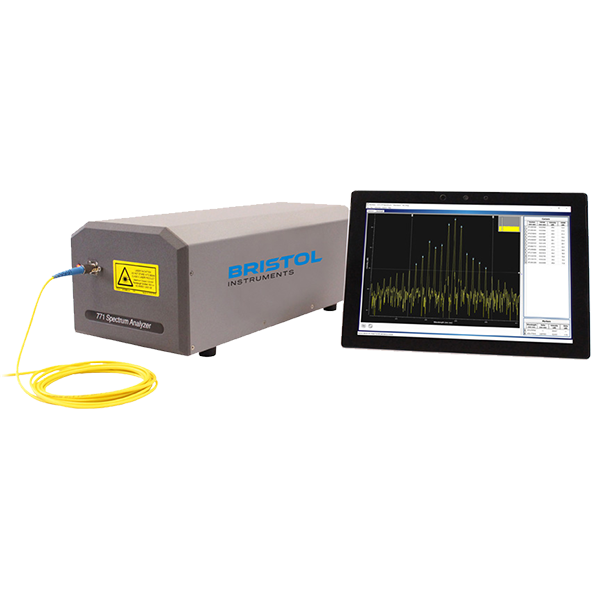
Bristol 771 Series — laser spectrum analyser from 375 nm to 12 µm
- For CW and high-repetition rate pulsed lasers
- Wavelength accuracy as high as ±0.0001 nm
- Wavelength measurement and spectral analysis in one instrument
- Operation available from 375 nm to 12 μm
- Continuous calibration with built-in HeNe laser reference
- Optical rejection ratio greater than 40 dB
The most precise wavelength and spectral measurement
The 771 Series laser spectrum analyser from Bristol Instruments combines proven Michelson interferometer technology with fast Fourier transform analysis resulting in a unique instrument that operates as both a high-resolution spectrum analyser and a high-accuracy wavelength meter. With spectral resolution up to 2 GHz, wavelength accuracy as high as ±0.2 parts per million, and an optical rejection ratio of more than 40 dB, the model 771 provides the most detailed information about a laser’s spectral properties.
771A vs 771B: continuous calibration for reliable accuracy
Two versions of the 771 laser spectrum analyser are available. The model 771A is the most precise, measuring wavelength to an accuracy of ±0.2 parts per million (±0.0002 nm at 1000 nm). For experiments that are less exacting, the model 771B is a lower-priced alternative with an accuracy of ±0.75 parts per million (±0.0008 nm at 1000 nm). These specifications are guaranteed by continuous calibration with a built-in wavelength standard, thereby ensuring the most meaningful experimental results.
Broad wavelength coverage and straightforward operation
The 771 laser spectrum analyser is available in four wavelength configurations: VIS (375–1100 nm), NIR (520–1700 nm), IR (1–5 µm), and MIR (1–12 µm). The system operates with a PC running Windows via USB or Ethernet. Software is provided to control measurement parameters, display spectra, and report wavelength data. The system can also be integrated into custom experiments using a library of commands for LabVIEW or other programming environments.
Key specifications
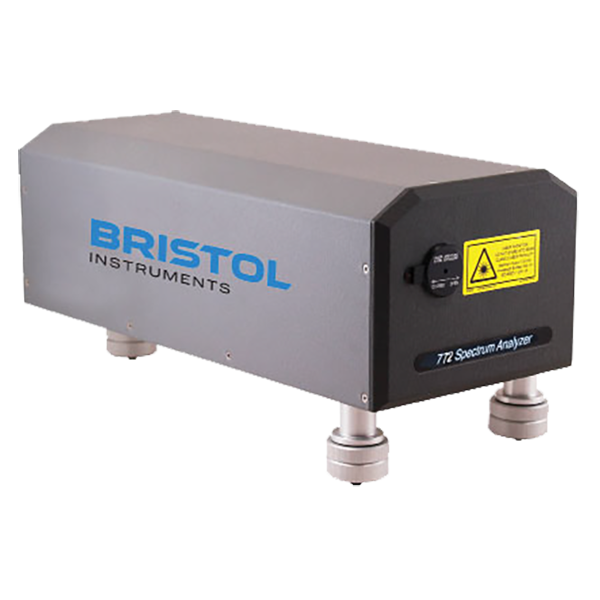
Bristol 772B-MIR — pulsed laser spectrum analyser for low repetition rate mid-IR lasers
- Spectral analysis of pulsed and CW lasers from 1 to 12 µm
- Pulsed laser measurement down to 100 Hz repetition rate
- Spectral resolution of 4 GHz
- Wavelength accuracy as high as ±0.01 nm
- Optical rejection ratio as high as 20 dB
Spectral analysis of pulsed IR and mid-IR lasers
The 772B-MIR laser spectrum analyser from Bristol Instruments combines proven Michelson interferometer technology with fast Fourier transform analysis to characterise the spectral properties of lasers that operate from 1 to 12 μm. What makes this system unique is that it employs a sophisticated co-additive algorithm to enable the measurement of pulsed lasers that have a repetition rate as low as 100 Hz — far below the minimum supported by the 771 Series.
The model 772B-MIR collects laser pulses over time to build an interferogram sufficient to convert to a spectrum. This spectrum has a resolution of 4 GHz and wavelength accuracy of ±10 parts per million (±0.08 nm at 8 µm). An optical rejection ratio of greater than 20 dB is achieved assuming a sufficient number of pulses (approximately 30,000) are used to generate the interferogram.
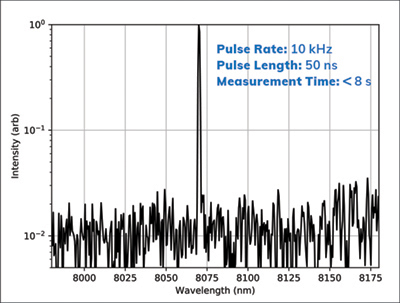
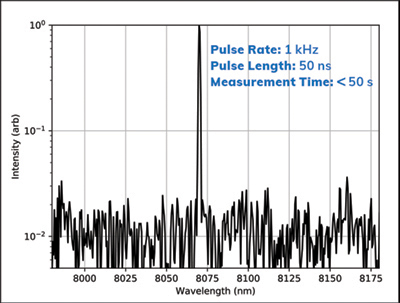
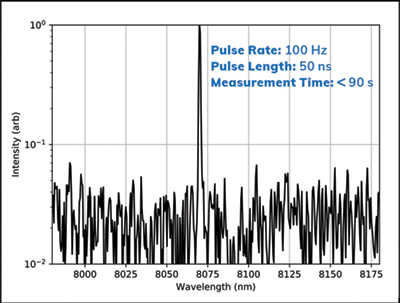
Spectra of a QCL operating with a pulse length of 50 ns at various repetition rates: