

























Why Motorised Linear Stages Transform Precision Motion Control
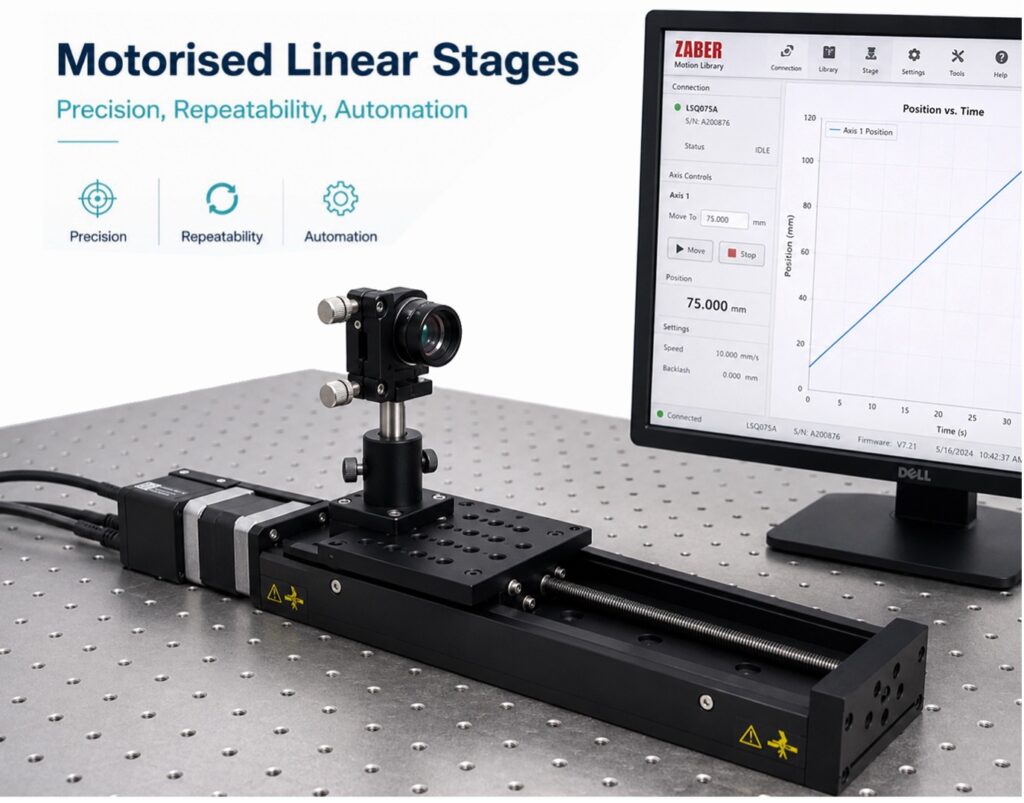
Linear stages are fundamental components in precision motion control. They allow a mounted object — such as an optic, sensor, camera, sample, fibre, probe or laser component — to move accurately along one or more linear axes. Manual linear stages remain useful for many simple positioning tasks, particularly where adjustments are infrequent or where budget is the main consideration.
However, many modern applications require more than occasional manual alignment. In photonics, microscopy, life sciences, metrology, semiconductor inspection and automated test environments, engineers increasingly need motion that is not only precise, but also repeatable, programmable and easy to integrate.
That is where motorised linear stages come into their own.
Rather than relying on a micrometer head or fine-pitch screw turned by hand, a motorised stage uses a stepper motor, servo motor or linear motor to drive controlled motion under software or electronic command. This brings major benefits in repeatability, automation, speed, traceability and multi-axis control.
For organisations developing optical systems, automated test rigs or laboratory instrumentation, motorised motion control can turn a careful manual process into a consistent, scalable workflow.
What is a motorised linear stage?
A motorised linear stage performs the same basic mechanical function as a manual translation stage: it enables controlled movement along the X, Y or Z axis while constraining unwanted motion such as pitch, yaw, roll or lateral drift. Manual linear stages are typically adjusted by micrometer heads or fine-pitch screws, and are used where accurate linear positioning is needed.
A motorised linear stage adds an integrated or external drive system. Depending on the product, this may include:
- A stepper motor, servo motor, or linear motor
- A lead screw, ball screw, belt drive
- Limit switches or encoders
- A built-in or separate controller
- Software/API control
- Digital I/O for synchronisation with other equipment
Zaber’s motorised linear stage range includes travel lengths from 10 mm to 3500 mm, load options up to 500 kg, speeds up to 3 m/s, and precision options including repeatability down to 50 nm and encoder resolution down to 1 nm, depending on the series selected.
That breadth matters because “linear stage” is not one product type. A compact microscope stage, a high-load industrial positioning axis and an ultra-precision linear motor stage may all be linear stages, but they solve very different problems.
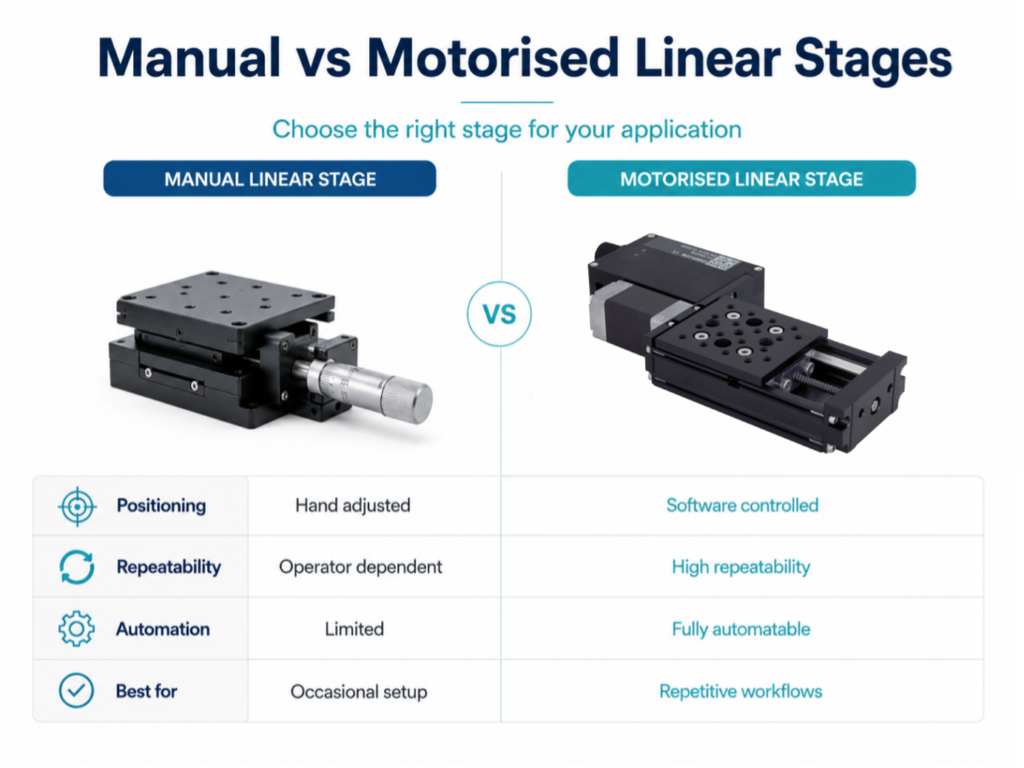
Manual vs motorised: the key difference
A manual stage is ideal when a user needs to “set and forget” a position. For example, aligning a lens during an experiment, moving a sample into view, or adjusting a fibre coupling setup by hand.
A motorised linear stage becomes preferable when the motion needs to be:
- Repeated many times
- Controlled remotely
- Automated through software
- Coordinated across multiple axes
- Logged or reproduced later
- Integrated into a larger instrument or production process
In other words, manual stages are excellent for human-controlled adjustment. Motorised stages are designed for system-controlled motion.
That distinction is becoming increasingly important as laboratories and manufacturers seek greater consistency, lower operator variability and more automated workflows.
Benefit 1: Repeatability you can build a process around
One of the strongest arguments for motorised motion control is repeatability.
With a manual stage, returning to the exact same position depends on the operator, the scale resolution, backlash, the feel of the micrometer and the precision of the mechanical design. Experienced users can achieve excellent results, but the process is still inherently manual.
A motorised stage allows positions to be defined digitally. Once a position is known, the system can return to it repeatedly with far greater consistency. With encoder feedback, the system can also verify actual position rather than relying only on commanded movement.
This is especially valuable in applications such as:
- Fibre alignment
- Microscope slide scanning
- Automated optical inspection
- Laser processing
- Detector positioning
- Repeatable metrology routines
Zaber’s motorised platforms include multiple feedback options, including limit switches, motor encoders for slip/stall detection and recovery, and linear encoders for higher accuracy.
Benefit 2: Automation and software control
The biggest practical difference between manual and motorised stages is automation.
A motorised linear stage can be controlled through software, scripts, user interfaces or external triggers. That means the stage can become part of a larger automated system rather than a standalone adjustment device.
This allows engineers to create routines such as:
- Move to position A
- Capture an image
- Move 100 µm
- Capture another image
- Repeat across a grid
- Return to home position
- Export measurement results
For laboratories, this can save significant time. For production or inspection systems, it can enable processes that would be impractical by hand.
Zaber highlights user-friendly software and APIs as part of its motorised linear stage offering, making it easier to build multi-axis systems and integrate motion control into automated workflows.
Benefit 3: Multi-axis motion made simpler
Many precision applications require movement in more than one axis. A manual XY or XYZ stage can be useful, but controlling multiple axes by hand becomes more difficult as complexity increases.
Motorised stages make multi-axis movement far more practical. An X, Y and Z axis can be controlled independently or coordinated as part of a sequence. This is particularly valuable for:
- Optical fibre alignment
- Laser beam positioning
- Microscopy automation
- Sample scanning
- Probe positioning
- Photonic device testing
Zaber’s stage families are designed to support multi-axis configurations, and many products can be daisy-chained or integrated into larger systems. The X-LSQ series, for example, includes built-in controllers and can daisy-chain with other Zaber products.
This reduces the amount of separate control hardware required and makes it easier to create compact, integrated motion systems.
Benefit 4: Better productivity and lower operator variability
Manual adjustment depends on the skill and attention of the user. In research, that may be acceptable. In production, inspection or high-throughput testing, it can become a source of inconsistency.
Motorised stages help remove operator variability by turning positioning into a repeatable process. This can improve:
- Test consistency
- Throughput
- Operator training time
- Quality control
- Traceability
For example, in a photonics production environment, a motorised stage can move a component through a predefined alignment or inspection sequence. The same motion profile can then be used across shifts, operators and sites.
This is not only faster — it is easier to validate.
Benefit 5: Remote operation and safer access
Some motion tasks take place in environments where manual adjustment is inconvenient or undesirable. Examples include:
- Enclosed laser systems
- Environmental chambers
- Vacuum systems
- Cleanrooms
- Long-duration experiments
- Automated production cells
A manual stage requires physical access. A motorised stage can be controlled remotely, allowing the user to make adjustments without opening an enclosure or disturbing the setup.
For laser-based systems, this can be particularly useful. The stage can be adjusted while the user remains outside the controlled area, provided the system has been designed safely and correctly.
Benefit 6: Built-in control reduces system complexity
Historically, motorised motion systems often required separate controllers, driver electronics, complex cabling and significant setup effort. That could make them feel intimidating compared with manual stages.
Modern integrated systems have changed that.
Laser 2000’s Zaber motion range includes linear stages with built-in controllers, combining precision and accuracy with straightforward ease of use. Zaber’s X-LSQ series, for example, is described as a high-speed motorised linear stage family with built-in controllers, integrated stepper motors, travel options from 75 mm to 600 mm, up to 50 kg load capacity and up to 1 m/s speed.
For many users, built-in controllers mean fewer boxes, fewer cables and faster deployment.
How to choose a motorised linear stage
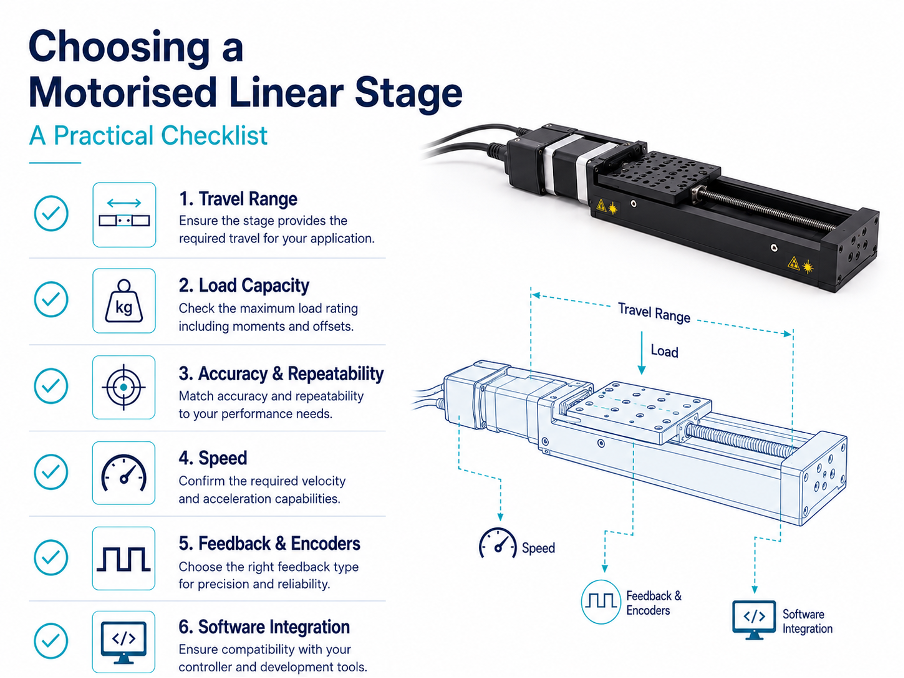
The selection criteria for a motorised stage overlap with manual stages, but with extra considerations. The manual stage guide highlights key stage selection factors including load capacity, travel range, positioning/repeatability accuracy and material choice. For a motorised stage, users should also consider:
- Travel range
How far does the stage need to move? A compact 25 mm travel stage may be ideal for microscope objective positioning, while a larger automated inspection system may need hundreds of millimetres or more.
- Load capacity
The stage must support the payload without compromising precision, lifetime or stability. This includes the mounted object and any fixtures, adapters or secondary stages.
- Accuracy and repeatability
Accuracy describes how close the stage gets to the commanded position. Repeatability describes how consistently it returns to the same position. For automation, repeatability is often the most important practical metric.
- Speed and acceleration
High-speed motion may be critical in scanning, inspection or production applications. Ultra-precision applications may prioritise smoothness and stability over speed.
- Feedback
Open-loop stepper systems may be sufficient for many applications. Encoder-equipped systems add position verification, slip/stall detection and higher confidence in automated operation.
- Form factor and mounting
The stage must physically fit the system. Consider height, footprint, mounting hole patterns, cable routing and whether the stage will be used in XY, XZ or XYZ configurations.
- Software and integration
Can the stage be controlled from the user’s preferred environment? Does it support scripting, API access, digital I/O or synchronisation with cameras, lasers or detectors?
Where motorised linear stages are used
Motorised motion control is valuable anywhere precise movement needs to become repeatable or automated. Common applications include:
- Microscopy and automated imaging
- Optical fibre alignment
- Photonics assembly
- Laser processing and beam delivery
- Semiconductor inspection
- Metrology and calibration
- Life science instrumentation
- Materials research
- Optical delay lines
- Automated test and measurement
Manual stages still have a place, particularly for simple adjustment tasks. But once the motion becomes repetitive, multi-axis, process-critical or software-driven, motorised motion control often becomes the better long-term solution.
Why Zaber through Laser 2000?
Zaber’s strength is combining precision motion hardware with practical usability. The range includes compact stages, high-load options, built-in controller models, encoder-equipped stages and longer travel systems. Zaber also offers standard and customised motorised linear stages, with travel lengths across a broad range and options for multi-axis systems.
For Laser 2000 customers, this makes Zaber suitable for both research users who need a simple first automation step and OEMs developing more complex instruments.
Laser 2000 can support users in selecting a stage based on the application, including travel range, load, accuracy, speed, footprint and control requirements.
Conclusion: from adjustment to automation
Manual linear stages remain useful, reliable tools for precision adjustment. But as photonics, microscopy, metrology and production systems become more automated, the benefits of motorised linear stages become increasingly clear.
Motorised motion control offers:
- Repeatable positioning
- Software automation
- Multi-axis coordination
- Remote operation
- Reduced operator variability
- Better throughput and traceability
For applications where motion is part of a repeatable process rather than a one-off adjustment, a motorised linear stage is not simply a convenience — it is an enabling technology.
With Zaber motorised motion control available through Laser 2000, users can move from manual positioning to reliable, integrated automation without unnecessary complexity.
Frequently Asked Questions (FAQs)
Q: Why choose a motorised linear stage over a manual one?
A: While manual stages are good for infrequent, budget-conscious positioning, motorised stages provide repeatable, programmable, and automated motion. They offer major benefits in speed, traceability, multi-axis control, and scalable workflow integration.
Q: What fields commonly use motorised linear stages?
A: They are frequently used in modern applications such as photonics, microscopy, life sciences, metrology, semiconductor inspection, and automated test environments.
Q: What components make up the drive system of a motorised linear stage?
A: The drive system typically includes a motor (stepper, servo, or linear), a drive mechanism (lead screw, ball screw, or belt drive), limit switches or encoders for position tracking, and a built-in or separate controller.