


































Operating Beams vs. Aiming Beams: Understanding Dual-Wavelength Laser Safety
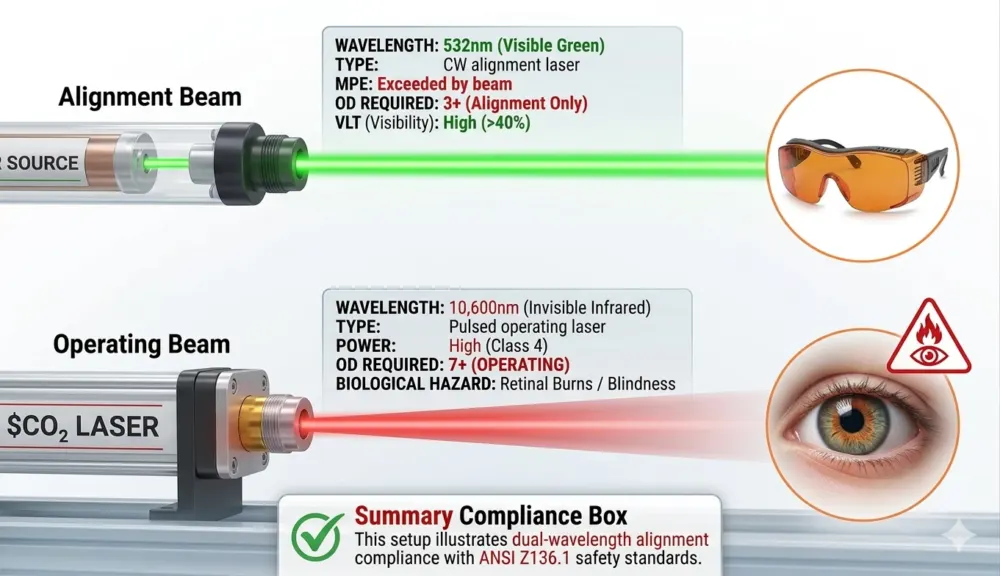
Many high-powered industrial and medical lasers utilize a dual-beam system. Because the primary laser performing the work is often invisible to the human eye (such as an Infrared or Ultraviolet laser), manufacturers pair it with a visible indicator beam.
Understanding the distinct safety requirements for both of these wavelengths is a critical responsibility for any Laser Safety Officer (LSO) or operator.
1. The Operating Beam (The Primary Hazard)
This is the high-powered beam designed to cut, weld, ablate, or engrave.
Visibility: Often invisible (e.g., a 10,600nm $CO_2$ laser or a 1064nm Nd:YAG laser).
Safety Requirement: Requires strict compliance with your laser’s specific Optical Density (OD) requirements. Exposure to this beam, even via a diffused reflection, can cause instantaneous and irreversible retinal damage.
2. The Aiming Beam (The Alignment Guide)
This is a low-powered, visible beam (typically red or green, such as a 632nm Helium-Neon or diode laser) used strictly to help the user position the operating laser.
The “Eye-Safe” Misconception: While commonly referred to as “eye-safe” (similar to a standard presentation laser pointer), you should never assume an aiming beam is completely safe for diffused viewing without verifying the output power.
The Risk: Recently, many facilities have introduced aiming beams with power outputs that exceed safe viewing thresholds without proper Personal Protective Equipment (PPE).
The MPE Balance: Alignment Eyewear vs. Standard Safety Glasses
During the alignment process, operators face a unique challenge: if your safety glasses block 100% of the visible spectrum, you cannot see the aiming beam to align the machine.
This is where Maximum Permissible Exposure (MPE) comes in. MPE is the highest level of laser radiation to which an eye can be exposed without hazardous effects.
The Solution: If your alignment beam exceeds the MPE threshold, you must use specialized Laser Alignment Eyewear. These lenses are engineered to precisely attenuate (reduce) the laser’s power to a safe level below the MPE, while maintaining enough Visible Light Transmission (VLT) so you can safely see the dot on your workstation.
Navigating these precise MPE and OD requirements can be complex. To ensure you are matching your facility’s specific wavelengths to the correct frame and filter type, we highly recommend reading our step-by-step breakdown: The Buyer’s Guide: How to Choose Laser Safety Glasses
Standard Operating Procedures for Laser Alignment
Proper personnel training and administrative controls are just as important as your physical PPE. Always follow these universal rules:
Never Look Directly into the Beam: This applies to all lasers, including the aiming beam.
Avoid the Axis: Do not bring your eyes near the laser’s axis during alignment or standard operation. Stand behind the beam while viewing it.
PPE is for Accidental Exposure: All laser safety glasses and goggles are designed to protect against unintentional direct hits and diffused viewing (scattered light) only. If you are hit in the eye, look away immediately.
When in Doubt, Ask: If you are unsure about the safety of your aiming beam, consult your facility’s Laser Safety Officer before making any assumptions.
Once your administrative controls and safety protocols are in place, the final step is equipping your team with reliable gear. If you already know your required OD and wavelength specifications, browse our fully certified collection of alignment and operating safety eyewear: Full Laser Safety Eyewear Offerings—Click Here