





























The Buyer’s Guide: How to Choose Laser Safety Glasses
When operating laser equipment, protecting your eyes is paramount. But with varying wavelengths, optical densities, and materials, knowing exactly what laser safety glasses to purchase can be overwhelming.
To ensure maximum safety and compliance, follow this step-by-step guide to choosing the correct laser safety eyewear.
Step 1: Identify Your Laser’s Wavelength
The most critical parameter when selecting laser safety glasses is your laser’s wavelength (or wavelength range). Often, a laser emits two specific wavelengths that you need to be aware of:
- The Aiming Beam Wavelength: Typically low-powered and red, this beam aids the user in positioning the laser. While often considered “eye-safe,” never look directly at any laser beam.
- The Operating Beam Wavelength: This is the high-powered working beam (often depicted as green in diagrams) that requires strict laser safety protection. Learn more about aiming vs operating beams here.
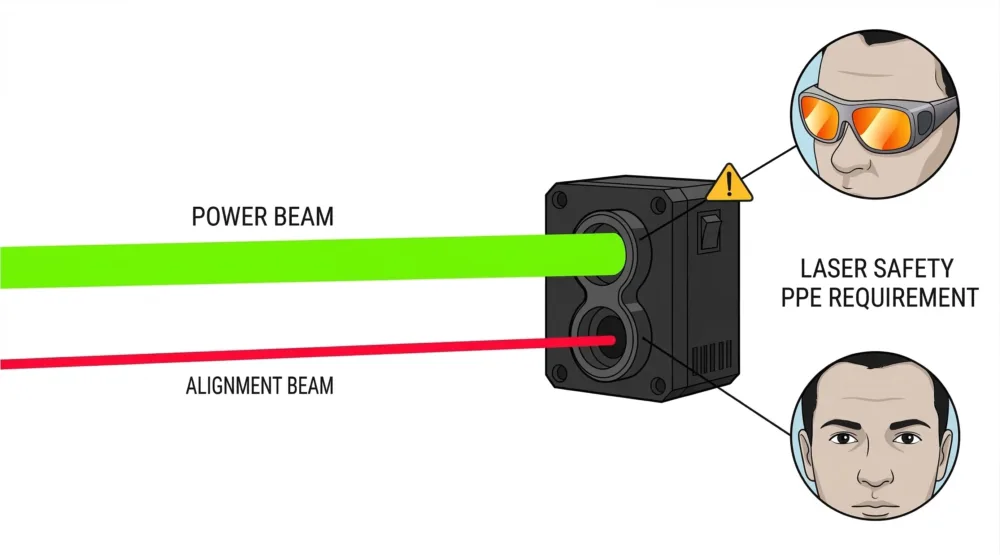
Safety Note: If you are unsure whether your aiming beam is safe for diffused viewing, do not make assumptions. Check with your Laser Safety Officer (LSO) or contact us. Recently, our team has encountered aiming beam wavelengths that require strict protection. All laser safety PPE is designed for unintentional direct and diffused viewing only. If a laser hits your eye, look away immediately.
Step 2: Determine Your Level of Protection & Equipment Needs
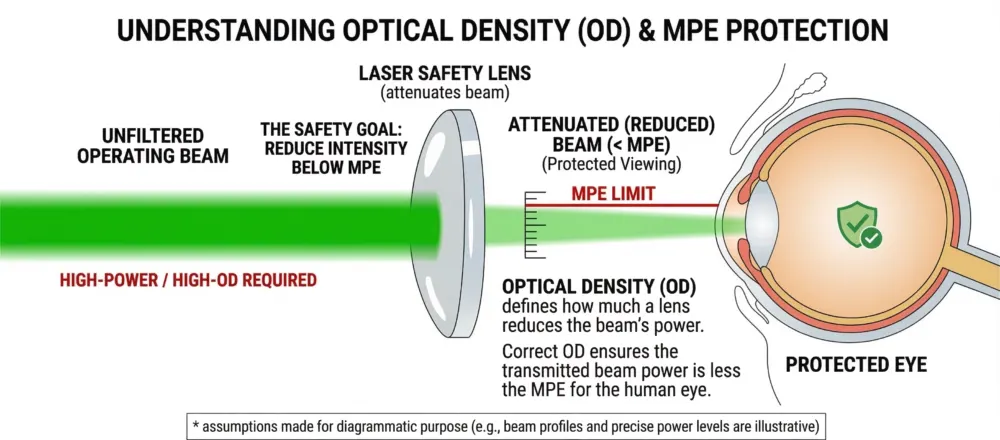
Optical Density (OD)
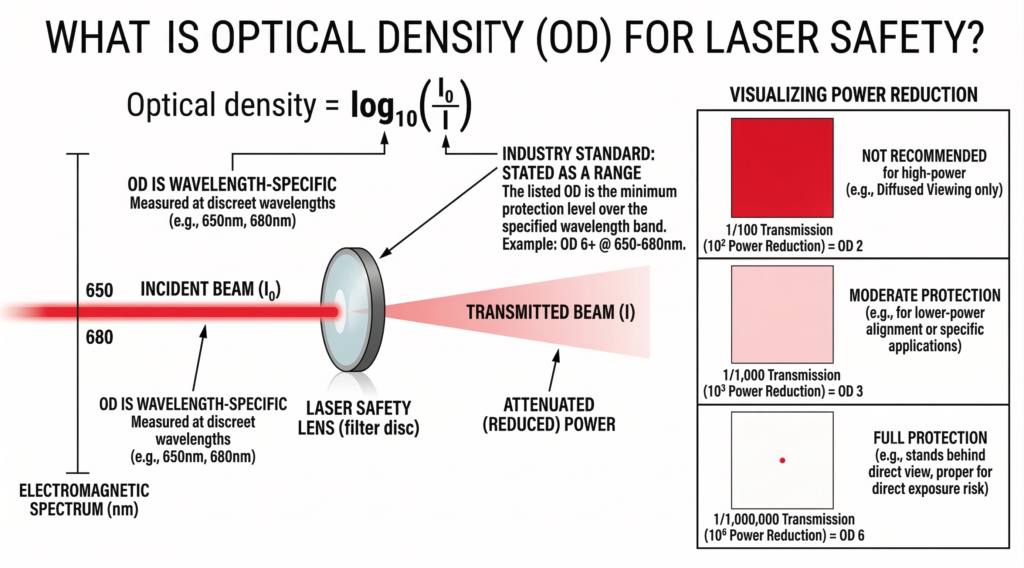
This refers to the amount of light attenuated by a lens and ultimately let through to hit the eye. Different lasers (and corresponding wavelengths) have different impacts on the human eye; the ANSI has created standards and published them based on research. For more information, see our guide on optical density in laser safety.
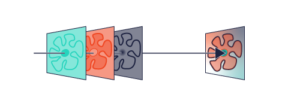
If there is any difficulty in knowing the appropriate optical density needed, do ask our experts. Below is a diagram to aid you in common industry notation. Kindly note that some assumptions have been made for diagrammatic purposes (photons are not drawn to scale).
Visible Light Transmission (VLT)
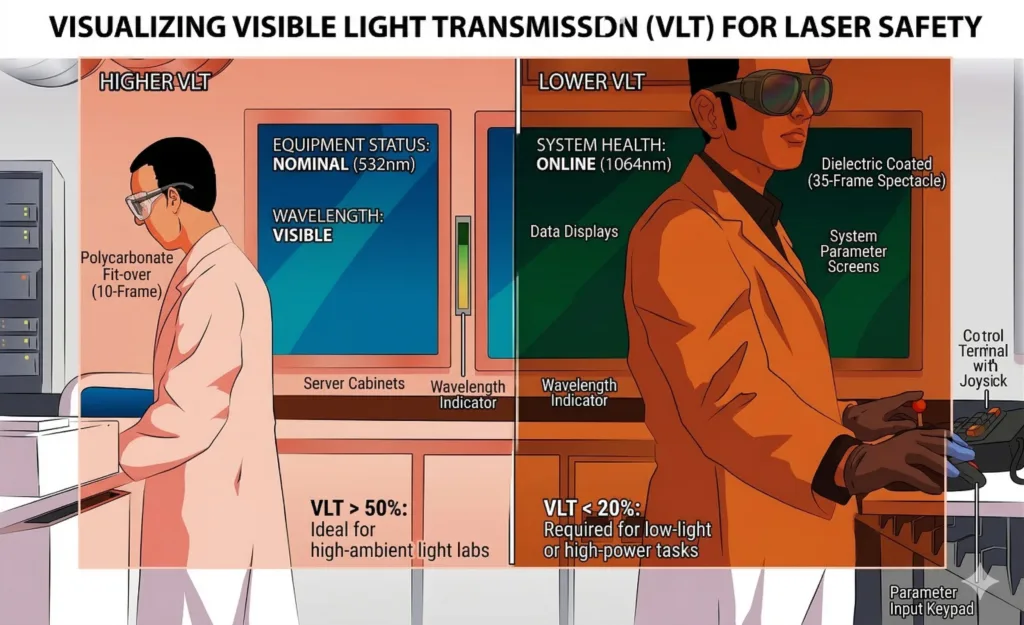
Color and visibility of specific color ranges often are significantly affected by laser glasses and goggles. Think about sunglasses—while effective at blocking the sun, less expensive lenses often make everything difficult to see because not enough light comes through. Quality laser eyewear ensures the target wavelength is blocked while maintaining high visibility for the user. The image below provides a relative comparison of visual light transmission.
Calculating Your Safety Rating
Laser safety eyewear from Laser 2000 is available with a wide range of filters. All safety spectacles and goggles are CE certified and conform to EN207 safety ratings.
Please get in touch to request a quotation if you know your required safety rating and we will provide a quote for eyewear with suitable filters.
If you do not know the EN207 safety rating needed for your laser eyewear, Laser 2000 offers a Laser Safety Calculation Form for you to complete. We run your laser parameters through our laser safety hazard assessment software and provide you with an assessment of the necessary protection level needed, free of charge, plus a quotation for the suitable filters.
Step 3: Choosing Your Filter Material
To meet your specific EN207 rating and operational needs, we offer several specialised filter technologies:
Plastic Absorption Filters: For cost-effective eyewear when using small to medium power levels, special plastics with absorbing dyes are used as the filter material. In the case of a laser hit, most of the laser energy is converted into heat and for this reason thermal stability is important. As standard, a scratch-proof coating is applied and for certain materials anti-fog, though small scratches do not effect safety.
Glass Absorption Filters: Glass filters are clearly superior to plastics, making them particularly suitable for use with continuous (cw) lasers of medium to high performance. Especially in the IR area, there are a number of powerful filters with very good color vision. In the case of a direct hit by high energy laser, the glass may break very quickly, therefore most filters have enhanced splinter protection as standard.
Reflective Coatings: For the highest level of protection, interference filters can be combined with absorbing filters for an almost unlimited number of blocking combinations. Incident light at angles different from 90 deg will be completely reflected according to the required angular range of +/- 30° (according to norms EN207/208). As a large part of the protection effect is based on reflection every scratch on the coated surface must be avoided.
Material Trade-offs
Below is a table to display generalized trade-offs of different laser safety glasses and goggles:
| Feature | Polycarbonate | Glass | Dielectric Coating |
|---|---|---|---|
| Weight | Lighter | Heavier | Heavier |
| Price | Lower | Medium | Higher |
| Wavelength Category | UV, Visible, Near/Far IR | Infrared (IR) | Varies (All across EM spectrum) |