



























The Ultimate Guide to Laser Safety Eyewear Standards: EN 207, EN 208, and ANSI Explained
Choosing the correct laser safety eyewear is a critical responsibility for any Laser Safety Officer (LSO) or facility manager. Whether you operate in a medical, industrial, or research environment, understanding the nuances of global laser safety standards—specifically EN 207, EN 208, and ANSI Z136—is essential for compliance and, most importantly, preventing irreversible eye injury.
If you are looking for a comprehensive breakdown on navigating these standards while shopping for the right frames and filters, we highly recommend reading The Ultimate Buyer’s Guide: How to Choose Laser Safety Glasses – Laser 2000.This guide breaks down everything you need to know about optical density, damage thresholds, CE marking, and how to properly select and maintain your Personal Protective Equipment (PPE).
The Danger of Relying Solely on Optical Density (OD)
Historically, and still predominantly under the American ANSI Z136 standard, laser safety goggles are specified by their Optical Density (OD). OD is the logarithmic measurement of how much a filter attenuates (blocks) light at a specific wavelength.
For example, an OD of 6 at 1064 nm means the eyewear reduces the transmitted light by a factor of 1,000,000.
The Fatal Flaw of OD
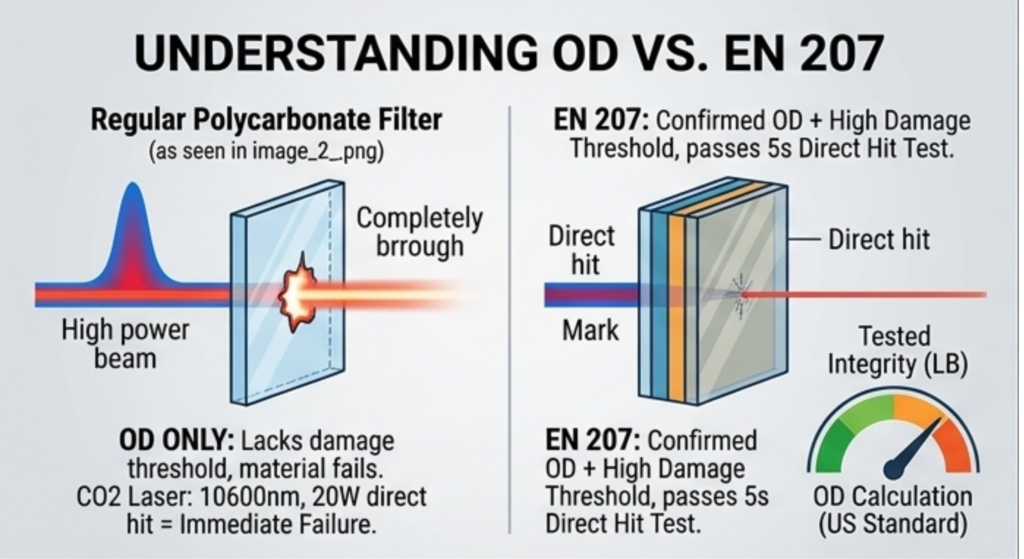
Specifying eyewear by Optical Density alone completely ignores the material’s damage threshold—the maximum power or energy density the eyewear can physically withstand before melting, shattering, or burning.
Imagine a high-power CO2 laser emitting at 10,600 nm. If you use polycarbonate safety glasses with an OD > 6, you might assume you are protected against a 10 kW beam. However, if that polycarbonate filter is subjected to a direct hit from even a 20 W beam, the material will burn through in seconds, rendering the Optical Density completely useless and exposing the eye to severe danger.
Decoding EN 207: The European Standard for Laser Safety
To solve the damage threshold problem, the European Union introduced EN 207. Since becoming a harmonized standard in 1997, any laser eye protection sold in the EU or UK must be certified to this standard (or EN 208 for alignment).
Under EN 207, laser safety eyewear is subjected to rigorous direct hit testing by an independent, government-approved notified body. Self-certification is strictly illegal.
To pass, the filter and frame must withstand a direct laser hit for at least 5 seconds (continuous wave) or 50 pulses (pulsed mode) without exceeding the critical safety limits (Class 1) on the eye side of the lens.
Understanding EN 207 Markings (LB Ratings)
When you purchase EN 207 certified glasses, they will feature specific markings indicating their LB Rating (formerly L-Rating prior to 2010). This rating combines both the required Optical Density and the tested damage threshold.
A typical marking looks like this: 315 – 1400 D LB5 I LB5 R LB6 M LB4
Here is how to decode the operating modes:
| Marking | Laser Operating Mode | Pulse Length | Common Applications |
|---|---|---|---|
| D | Continuous Wave (CW) | N/A | Cutting, welding, medical lasers |
| I | Long Pulse | 1 µs to 250 ms | Hair removal, aesthetics |
| R | Q-Switched | 1 ns to 1 µs | Tattoo removal, LIDAR |
| M | Femtosecond / Picosecond | < 1 ns | Microscopy, precise material ablation |
The LB Number (e.g., LB5, LB6) dictates the maximum power or energy density the eyewear can withstand. An increase of 1 in the LB number equates to a tenfold increase in protection (one order of magnitude).
EN 207 Protection Levels (LB Ratings)
Use the table below to determine the required protection level based on the laser’s power or energy density.
| Scale Number | Max Transmission | D (W/m²) CW | I, R (J/m²) Pulsed | M (W/m²) Femto |
|---|---|---|---|---|
| LB1 | 10% | 100 | 0.05 | 0.0015 |
| LB3 | 0.1% | 10,000 | 5 | 0.15 |
| LB5 | 0.001% | 1,000,000 | 500 | 15 |
| LB7 | 0.00001% | 100,000,000 | 50,000 | 1,500 |
EN 208: Laser Alignment Eyewear
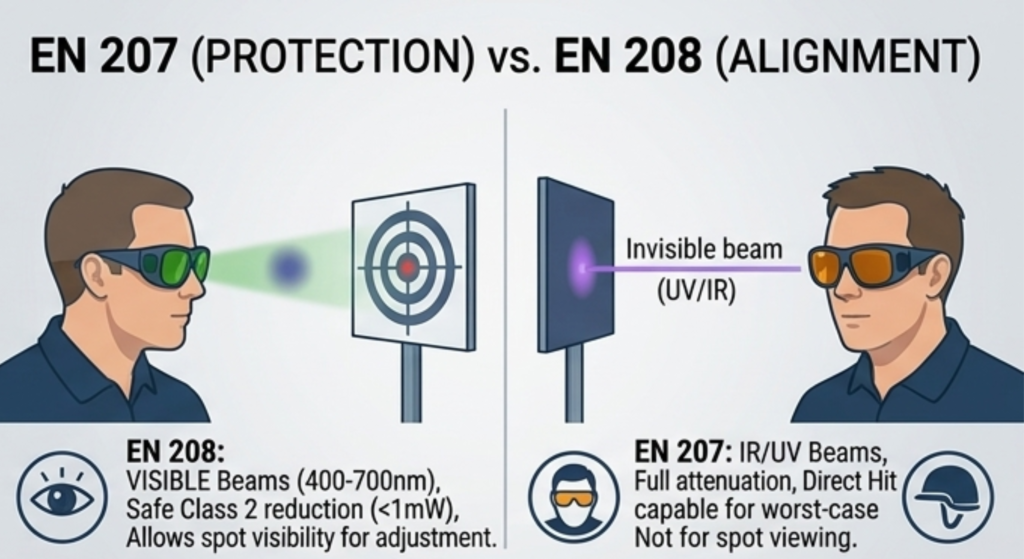
While EN 207 is for complete protection, EN 208 dictates the standards for laser alignment glasses. These are designed exclusively for adjusting visible-beam lasers (400 nm to 700 nm).
Instead of completely blocking the beam, EN 208 glasses attenuate the incident power down to a safe Class 2 level (< 1 mW). This allows the technician to safely see the beam spot for alignment purposes. Like EN 207, they are rated by damage thresholds (labeled as RB levels) and must survive the 5-second / 50-pulse direct hit test.
EN 208: Laser Alignment Eyewear
EN 208 dictates the standards for laser alignment glasses (visible beams 400nm – 700nm). These reduce power to a safe Class 2 level (< 1mW) so you can still see the beam spot for adjustment.
EN 208 Alignment Levels (RB Ratings)
| Scale Number | Max Power (W) | Max Pulse Energy (J) | Spectral Transmission |
|---|---|---|---|
| RB1 | 0.01 | 0.000002 | 0.01 to 0.1 |
| RB2 | 0.1 | 0.00002 | 0.001 to 0.01 |
| RB3 | 1 | 0.0002 | 0.0001 to 0.001 |
| RB4 | 10 | 0.002 | 0.00001 to 0.0001 |
| RB5 | 100 | 0.02 | 0.000001 to 0.00001 |
EN 207 vs. ANSI Z136: A Global Comparison
Depending on your region, you will follow different legal frameworks. Here is a quick comparison of the European and American approaches:
| Feature | EN 207 (Europe / UK) | ANSI Z136 (USA) |
|---|---|---|
| Primary Metric | LB Rating (Damage Threshold + OD) | Optical Density (OD) alone |
| Direct Hit Testing | Mandatory (5 seconds or 50 pulses) | Not required by the standard |
| Certification | Independent Notified Body required | Self-certification allowed |
| Focus | Guaranteed structural integrity | Attenuation of light within the NHZ |
Note on the Nominal Hazard Zone (NHZ): ANSI allows a Laser Safety Officer to define an NHZ. Outside this zone, standard OD-rated eyewear is considered adequate against stray light, whereas EN 207 requires worst-case scenario testing regardless of zone.
Legal Compliance: CE Marking and UKCA
Under Personal Protective Equipment (PPE) Regulations, it is illegal to sell non-certified laser safety glasses in Europe.
CE Mark: Mandatory for all PPE sold within the European Economic Area. It proves the eyewear has passed EN 207/208 independent testing.
UKCA Mark: Following Brexit, the UKCA mark was introduced. However, the UK government currently accepts the CE marking indefinitely for PPE. You will likely see the UKCA mark gradually phased out on newer eyewear, but CE remains an absolute legal necessity.
How to Calculate and Select the Right Laser Safety Glasses
Do not guess when it comes to eye safety. To specify the correct LB numbers for your facility’s laser, an LSO should follow these steps:
Determine Beam Diameter: Find the minimum accessible beam diameter under reasonably foreseeable circumstances.
Calculate Area: Calculate the cross-sectional area of the beam.
Find Power/Energy Density: * For CW Lasers: Divide average power by beam area.
For Pulsed Lasers: Divide energy per pulse by beam area (apply correction factors for high repetition rates as per EN 207 guidelines).
Consult Table B1: Use Table B1 in the EN 207 standard to match your calculated density to the required LB number.
Match the Mode: Precede the LB number with the correct letter (D, I, R, or M).
If you are unable to find a filter that matches all your precise parameters, safety regulations mandate performing a thorough risk assessment to find a CE-certified filter that closest meets the basic EN 60825-1 requirements.
To browse fully compliant options that cover all EN207 and EN208 standards, explore the full catalogue of Laser Safety Eyewear- Laservision – Glasses – Large Area Protection – Laser 2000.
Inspection and Maintenance: When to Replace Your Eyewear
Even the highest-rated EN 207 safety glasses are only effective if they are in good condition. Implement a strict inspection routine:
Daily Inspection Routine
Inspect Before Every Use: Look for deep scratches, pitting, or discoloration on the lens. Polycarbonate lenses are particularly prone to scratching.
Check the Frame: The frame provides the same level of protection as the filter. If the frame is cracked, warped, or if the lenses are loose, discard the glasses immediately.
Beware of UV Degradation: Some polymer filters can degrade over time when exposed to heavy UV light or harsh cleaning chemicals.
Direct Hits: If you suspect the glasses have taken a direct hit from a laser beam, they must be permanently retired from service immediately, even if the damage is not visible to the naked eye.