



























What is Optical Density (OD) in Laser Safety? Values Explained
Choosing the correct laser safety eyewear isn’t just about finding “green or red glasses.” It’s about matching the precise Optical Density (OD) to your laser’s wavelength. Failing to understand this metric can lead to permanent retinal damage in a fraction of a second.
What is Optical Density (OD)?
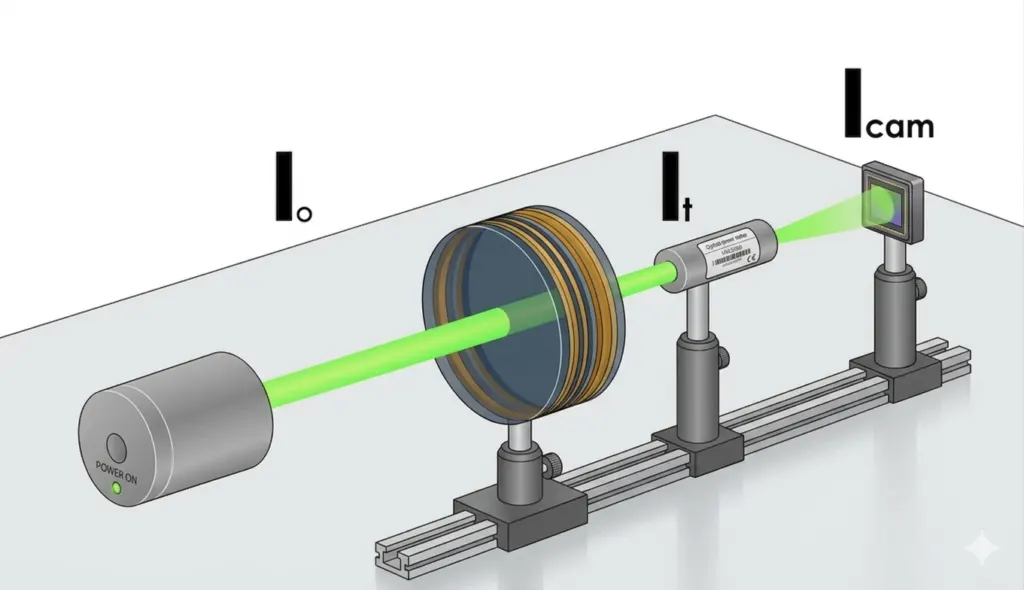
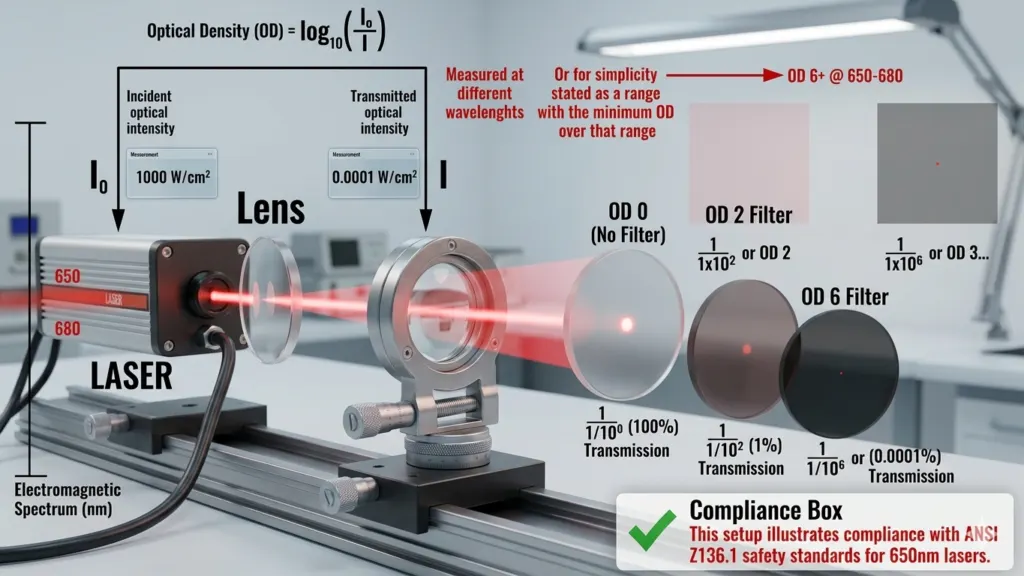
In the context of laser safety, Optical Density is a measure of how much laser radiation at a specific wavelength is blocked (attenuated) by a safety lens.
Unlike standard sunglasses, laser safety filters are engineered to absorb or reflect concentrated energy. The higher the OD number, the lower the transmission of that specific laser light to your eye.
The Physics of Protection: The Logarithmic Scale
OD is calculated on a logarithmic scale. This means that a small increase in the OD number represents a massive increase in protection.
OD 1+: Blocks 90% of the beam (1/10th of the light passes through).
OD 2+: Blocks 99% of the beam.
OD 4+: Blocks 99.99% of the beam.
OD 7+: Blocks 99.99999% of the beam.
Crucial Note: You must consult your Laser Safety Officer (LSO) or use the ANSI Z136.1 standards to determine the “Maximum Permissible Exposure” (MPE) for your specific laser to choose the right OD.
Navigating Wavelengths: Aiming vs. Operating Beams
Most industrial and medical lasers use two distinct beams. Confusing them can be a fatal mistake for your eyesight.
1. The Operating Beam (High Power)
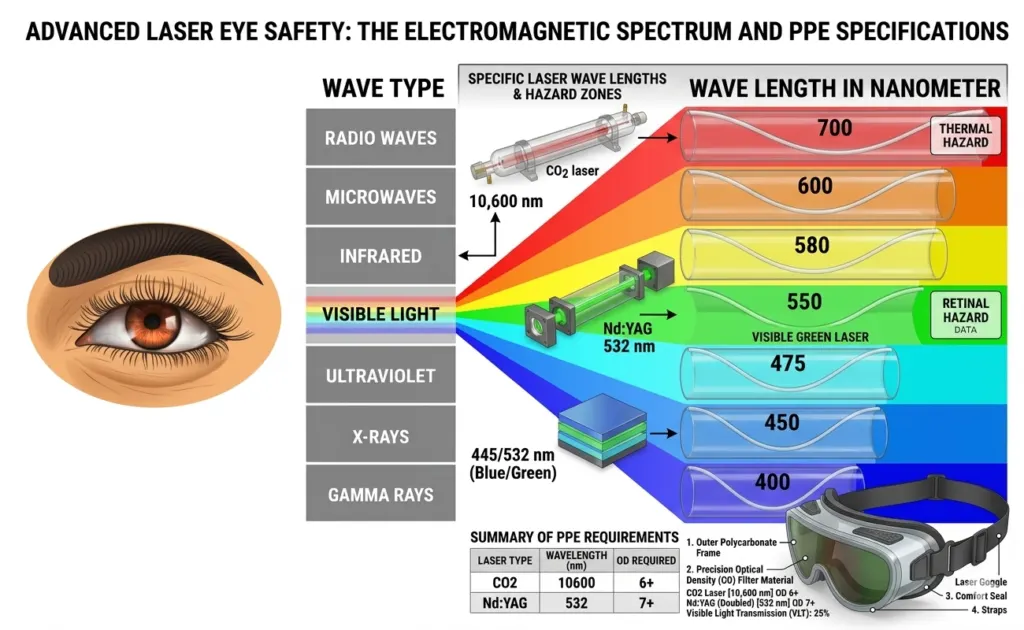
This is the beam performing the work (cutting, ablating, or welding). It is often invisible (Infrared or UV). You require high-OD eyewear specifically rated for this wavelength.
2. The Aiming/Alignment Beam (Low Power)
To help you see where the invisible operating beam is pointed, manufacturers include a visible “aiming beam” (usually red or green).
The Danger: Many assume aiming beams are “eye-safe.” In reality, even a low-power alignment beam can exceed MPE thresholds.
The Solution: You need Alignment Eyewear. These are designed to reduce the beam to a safe level while still allowing you to see the “dot” so you can work accurately.
Expert Q&A: Common Safety Misconceptions
Q: If my goggles are rated OD 7 for 190nm–385nm, am I safe at 110nm? A: Absolutely not. Laser filters are highly specialized chemical or dielectric coatings. Protection does not “bleed” over into adjacent wavelengths. Using eyewear outside its tested range is a leading cause of lab accidents. Always match your eyewear to the exact nanometer (nm) of your laser.
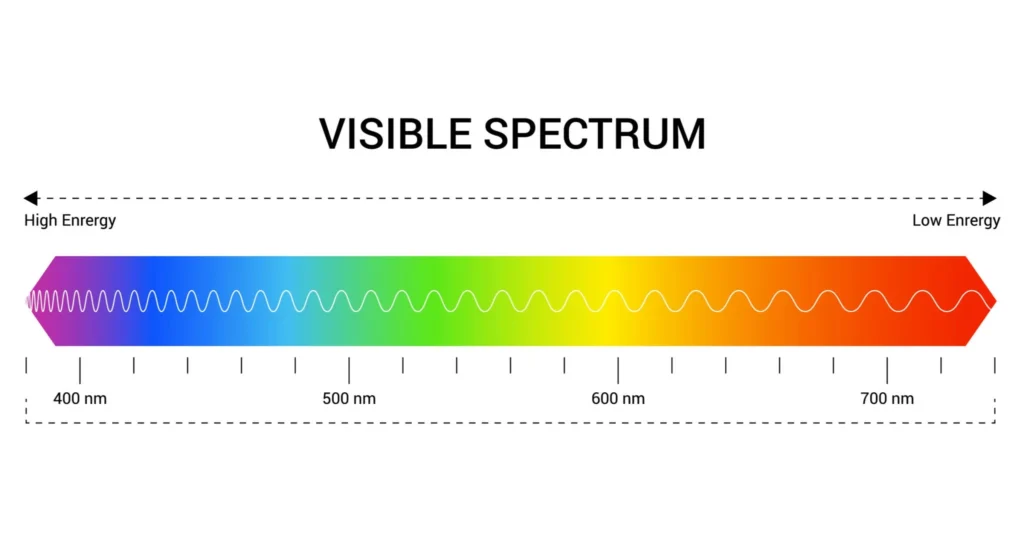
Q: Can I get “Universal” laser goggles that block everything? A: Technically, yes—but you wouldn’t be able to see. Blocking every laser wavelength would require blocking the entire visible light spectrum. This brings us to VLT (Visible Light Transmission). If your VLT is too low (below 20%), you won’t see your environment clearly, which creates trip hazards and operational errors.
Q: Should I wear two pairs of safety glasses for “extra” protection? A: No. This is a dangerous practice. Stacked lenses create internal reflections, reduce VLT to near-zero, and cause physical discomfort that leads to “safety fatigue” (where the user eventually takes the glasses off entirely). Instead, use a single pair of Multi-Wavelength goggles specifically certified for your multi-laser setup.
Why Compliance Matters
All our eyewear meets or exceeds ANSI Z136.1 (USA) and EN 207/208 (Europe) standards. When you buy from Laser 2000, you are not just buying a product — you are buying certified, lab-tested radiation protection backed by our expert technical support team.Still Unsure Which Frame or Filter You Need?
Understanding Optical Density is only the first half of the safety equation. You also need to consider frame fit, filter material (Glass vs. Polycarbonate), and VLT (Visible Light Transmission) to ensure you can work both safely and comfortably.
For a comprehensive, step-by-step walkthrough on matching eyewear to your specific environment, read our companion guide: The Ultimate Buyer’s Guide: How to Choose Laser Safety Glasses
Once you have your specifications ready, browse our certified collection: Laser safety eyewear for all wavelengths and laser classes