





















Motorised Linear Actuators: The Complete Guide for Photonics and Lab Automation
If you have ever spent twenty minutes with a hex driver trying to hit a fibre coupling sweet spot — only to lose it the moment your hand moves away — you already understand why motorised linear actuators exist. This guide covers everything: how they work, the specifications that actually matter, the different motor types, how to daisy-chain multiple axes, and how to choose the right motorised linear actuator for your specific application in photonics, microscopy, or lab automation.
What Is a Motorised Linear Actuator?
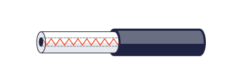
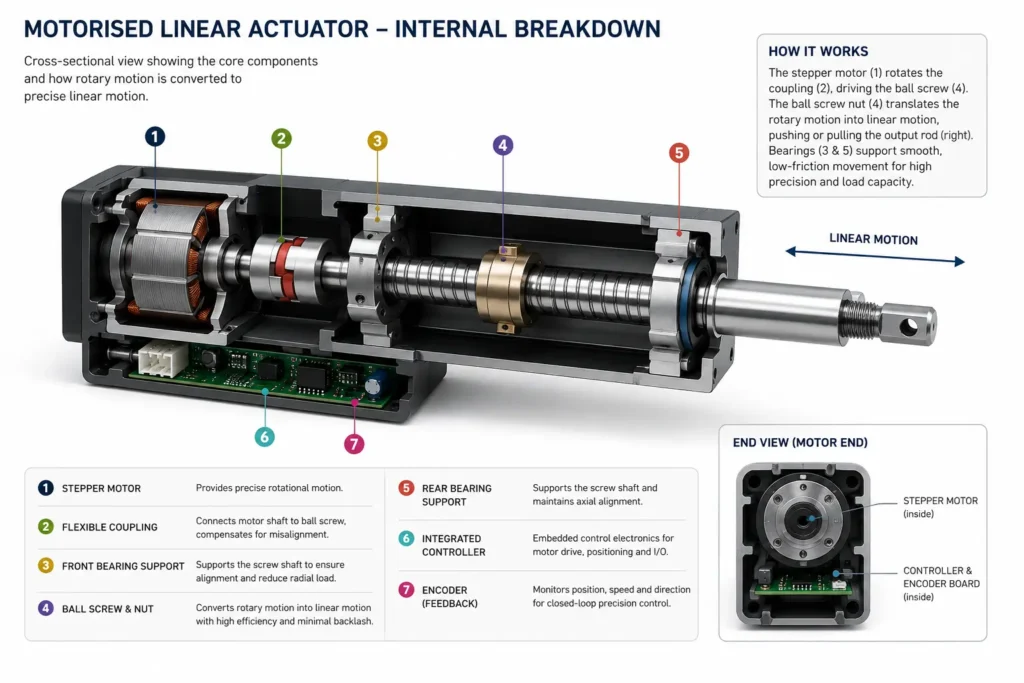
A motorised linear actuator is a device that converts the rotational output of an electric motor into precise, controllable linear motion along a single axis. The motor drives a lead screw or ball screw; as the screw rotates, a nut translates along it, pushing or retracting the output shaft. Software — running on a PC, Raspberry Pi, or embedded controller — sends commands that determine direction, distance, speed, and position.
In photonics and optics, motorised linear actuators serve a fundamentally different purpose from their industrial cousins. Where an industrial actuator might push a machine guard or tilt a solar panel, a photonics-grade motorised linear actuator is about positional repeatability at the micrometre level — nudging an optical fibre, adjusting a mirror mount, or repositioning a sample stage with sub-micron confidence.
The defining advantage over manual adjustment is reproducibility. A motorised actuator returns to a stored position without operator variability, enabling automated experiments, remote operation, and multi-step workflows that simply cannot be done by hand.
How Does a Motorised Linear Actuator Work?
At its core, a motorised linear actuator contains three functional elements.
The motor — most commonly a stepper motor (used for discrete, open-loop position steps) or a DC servo motor (used with closed-loop position feedback). Stepper motors dominate photonics-grade actuators because their inherent step size provides predictable positioning without an encoder, though encoder variants add stall/slip protection.
The drive mechanism — a precision lead screw or ball screw converts rotation into linear displacement. The lead (distance per revolution) determines the relationship between motor steps and linear travel. A finer lead gives higher resolution; a coarser lead gives higher speed for the same motor RPM.
The controller — historically a separate, rack-mounted box with its own power supply and communication interface. Modern precision actuators — including the entire Zaber range available from Laser 2000 — integrate the controller directly into the actuator body, eliminating the external box entirely and simplifying the bench setup dramatically.
Optional motor encoders detect slip or stall events — situations where the motor has stepped but the screw has not moved, typically from a mechanical obstruction or overload. Encoder feedback allows the controller to re-home and correct position errors automatically.
Key Specifications Explained
Repeatability
Repeatability is the most important specification for photonics applications. It describes how precisely the actuator returns to a previously commanded position after moving away. A repeatability of 1 µm means that after any number of moves, the actuator returns to within one micrometre of the target — consistently.
Do not confuse repeatability with accuracy. Accuracy describes how closely the actual position matches the commanded position in absolute terms; this depends on lead screw manufacturing tolerances and changes over time. Repeatability is often far better than absolute accuracy and is the figure that matters most for experimental reproducibility.
Zaber actuators available from Laser 2000 achieve 1 µm repeatability — sufficient for demanding fibre coupling, interferometric setups, and automated laser alignment.
Travel
Travel is the total range of linear motion the actuator can produce. Photonics actuators typically offer 16, 25, 30, or 60 mm of travel. For most optical alignment tasks — adjusting a mirror mount, optimising fibre coupling, or fine-tuning a beam expander — 25 mm is more than sufficient. Longer 60 mm travel suits sample scanning and positioning of larger optical assemblies.
Thrust Force
Thrust is the maximum force the actuator can exert along its axis. In photonics, loads are rarely heavy: mounting an optical component on a carriage or driving a mirror mount requires grams of force, not kilograms. Zaber’s range covers from around 25 N for compact built-in-controller models through to over 1,000 N for externally-controlled variants, giving application-matched force without oversizing.
Resolution vs Speed
Resolution and speed are inversely related in most stepper-motor actuators — microstepping increases resolution at the cost of maximum speed. For alignment tasks, resolution matters more than speed. For automation workflows involving many sequential moves (sample scanning, wafer inspection), higher speed becomes valuable. Select a model whose speed/resolution balance suits your workflow rather than defaulting to the highest resolution available.
Types of Motorised Linear Actuators
Stepper Motor Linear Actuators
The most common type in photonics applications. The motor divides each revolution into discrete steps (typically 200 full steps per revolution, with up to 64× microstepping available on advanced controllers). Open-loop steppers are reliable for repeatable moves within their force rating; encoder-equipped variants add closed-loop protection.
Advantages: Predictable positioning, lower cost, widely supported by standard motion control software.
Best for: Optical alignment, mirror mount automation, fibre positioning.
Servo Motor Linear Actuators
DC servo motors with rotary encoders and closed-loop control. They offer higher speed, continuous position feedback, and better performance under varying loads, but are typically more expensive and require more complex tuning.
Best for: High-throughput automation, scanning applications, tasks with variable load conditions.
Piezoelectric Actuators
Piezo actuators use the inverse piezoelectric effect to generate nanometre- to micrometre-range motion with extremely high stiffness and bandwidth. They have limited travel (typically under 1 mm) but exceptional speed and resolution.
Best for: Active vibration cancellation, fast tip-tilt correction, applications requiring sub-nanometre steps. Note: piezo actuators are a separate product category — contact Laser 2000 for piezo positioning advice.
Voice Coil Actuators
Electromagnetic actuators with no mechanical transmission, offering zero-friction, high-bandwidth motion. Very limited travel; typically used for speaker-like force output or fast oscillating motion.
Daisy-Chaining Motorised Linear Actuators for Multi-Axis Control
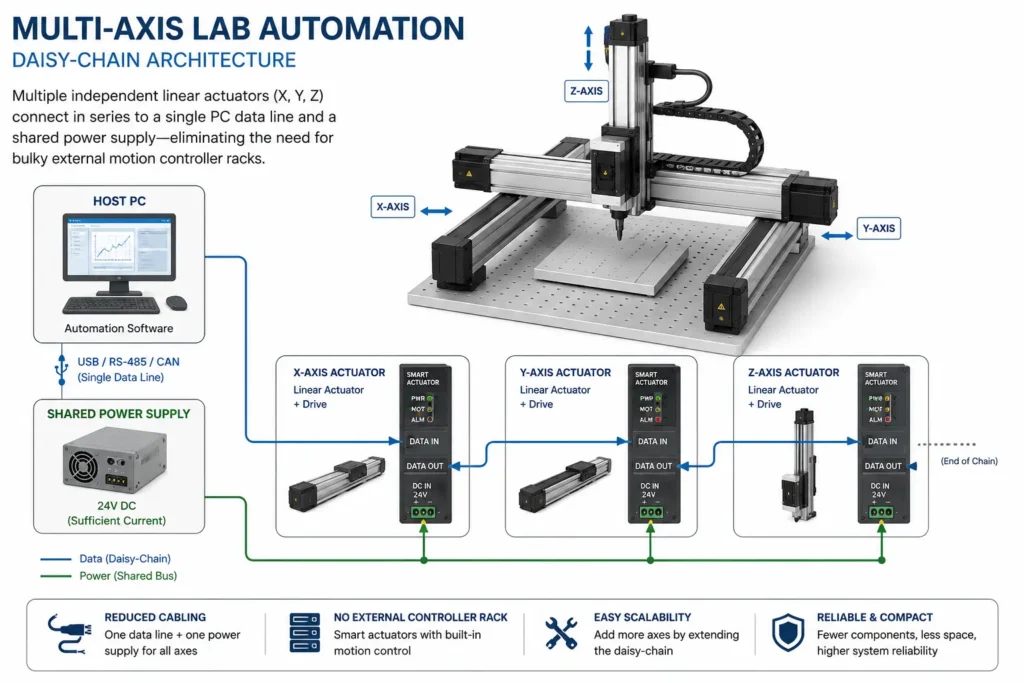
One of the most powerful features of modern precision motorised linear actuators is the ability to connect multiple devices on a single data line. Zaber’s bus protocol allows up to 99 actuators to share one USB or RS-232 connection, with each device addressed individually.
Here is how a typical daisy-chain setup works:
- Connect the first actuator to your PC via USB (or RS-232 with a USB adaptor).
- Connect the data-out port of actuator 1 to the data-in port of actuator 2.
- Continue chaining for actuators 3, 4, and beyond.
- Power can be shared: up to three devices share a single power supply when using built-in-controller models.
- Open Zaber Launcher software, which automatically detects all connected devices.
- Send move commands to individual axes or coordinate simultaneous multi-axis moves.
For a three-axis fibre alignment rig — X, Y, and Z — this means a single USB cable and one power supply control the entire assembly. There is no motion controller rack, no separate breakout board, and no complex wiring. Setup time drops from hours to minutes.
When your application calls for planar motion across two axes rather than driving individual mounts, XY stages combine two motorised axes into a single integrated unit — useful for sample scanning, wafer positioning, and automated inspection workflows where a carriage platform is needed alongside the motion.
Motorised Linear Actuators vs Other Motion Systems: Which Do You Need?
This is the most common question from engineers specifying precision motion for the first time.
A motorised linear actuator is a standalone positioning device designed to interface with existing hardware. It typically has a threaded or standard-diameter output shaft that drops into existing optical hardware — replacing a manual adjustment screw or micrometer head. It does not include its own carriage or travel rail.
A motorised linear stage includes a complete translation carriage riding on a precision rail, with the actuator built in. It provides a full mounting surface for optical components, making it the right choice when you need to move a component from scratch rather than drive an existing mount.
For microscopy work specifically — where sample positioning, focus control, and objective alignment all demand sub-micron repeatability — motorised microscope stages are engineered for those exact requirements, with stage geometries matched to standard microscope body formats.
If you are retrofitting existing manual mounts in your optical system, an actuator is almost always the right choice. If you are building a new positioning platform from a blank optical table, a stage gives you more mounting flexibility. For applications that require rotation as well as linear displacement — rotating a polariser, indexing a filter wheel, or aligning a fibre array — rotary stages complement linear actuators cleanly without introducing any cross-axis coupling.
Choosing the Right Motorised Linear Actuator: A Decision Framework
Work through these questions in order:
1. Do I need to retrofit existing hardware or build from scratch?
Retrofit → actuator. New build → consider a stage.
2. What repeatability do I need?
Visible-light optical alignment (fibre coupling, mirror mounts): 1 µm is the standard benchmark. Interferometry or holography: aim for sub-micron. Coarse sample positioning: 5–10 µm may be acceptable.
3. How many axes, and how complex is the control?
Single axis, occasional moves: any model with USB control. Multi-axis automated sequences: choose daisy-chain-compatible models with built-in controllers.
4. Do I need stall protection?
If the actuator could encounter unexpected resistance during an experiment (motorised aperture, spring-loaded mount), choose an encoder-equipped model.
5. What travel do I need?
Measure the range of your current manual adjustment and add 20% margin. Most photonics applications fit within 25–60 mm.
6. Is space a constraint?
Built-in controller models are compact but have slightly lower thrust. External controller models allow higher force from a smaller actuator body.
Motorised Linear Actuators for Common Photonics Applications
Fibre coupling — The most demanding precision application. Use a 3-axis actuator array (X, Y, Z) with encoder feedback and 1 µm repeatability. Daisy-chain to a single USB port for software-controlled peak-finding routines.
Mirror mount automation — Replace the thumb screws on a commercial mirror mount with a motorised actuator pair (tip/tilt). Zaber actuators with standard 3/8″ or metric shank fit most popular mount formats.
Beam steering — Motorised actuators driving galvo-mirror mounts allow computer-controlled beam routing in laser systems. Where continuous angular adjustment is needed alongside linear positioning, pairing an actuator with a rotary stage gives full angular and translational freedom on the same optical axis.
Automated sample scanning — Mount a sample on a motorised stage driven by high-resolution actuators for spectroscopic mapping, fluorescence imaging, or surface profilometry. For dedicated microscopy imaging workflows, motorised microscope stages offer slide-holder and well-plate formats optimised for those environments.
Spectroscopy and monochromators — Drive diffraction grating rotation or slit-width adjustment remotely, enabling automated wavelength scanning without physical access to the instrument.
Large-area automation — When the application outgrows single-axis or bench-scale positioning — automated inspection of large substrates, pick-and-place over a wide work area, or multi-zone beam delivery — gantry systems extend the same motorised precision across X–Y travel ranges that individual actuators cannot cover.
Complex multi-axis handling — For applications that combine linear positioning with end-effector orientation — gripping and placing optical components, automated assembly, or six-degree-of-freedom sample manipulation — high-precision robotic arms bring programmable articulated motion to the photonics lab without the cost of industrial robot infrastructure.
Software and Integration
Zaber actuators are supported across the most common lab automation environments:
- Zaber Launcher — GUI-based control for immediate manual and scripted operation, no programming required
- Python (Zaber Motion Library) — pip-installable library for scripted automation, compatible with common lab frameworks
- MATLAB — Native Zaber toolbox for experimental scripting
- LabVIEW — VI library for integration with NI hardware environments
- ASCII protocol — For custom integrations with any serial-capable software
Frequently Asked Questions
Can motorised linear actuators be used in vacuum?
Standard Zaber actuators are not rated for high vacuum. Contact Laser 2000 if your application requires vacuum-compatible motion — specialist solutions are available.
What is the minimum incremental motion of a Zaber motorised linear actuator?
Minimum incremental motion (one microstep) is typically 50–100 nm depending on model configuration, making these devices capable of extremely fine optical adjustments.
Do motorised linear actuators need calibration?
Zaber actuators use a home reference position established at power-up. They do not require periodic calibration. After homing, the controller tracks position in absolute encoder counts throughout the session.
Can I control Zaber actuators wirelessly?
Not natively. Control is via USB or RS-232. For remote lab automation, a USB-over-Ethernet adaptor or a single-board computer (Raspberry Pi) at the bench can enable network control.
Summary
Motorised linear actuators bring reproducible, software-controlled precision to optical setups that would otherwise depend on manual skill and patience. The Zaber range — available from Laser 2000 with UK pricing and specialist photonics support — offers 1 µm repeatability, built-in controllers, and daisy-chain networking that makes multi-axis automation genuinely simple.
Browse the full range of motorised linear actuators or contact our photonics applications team for a free specification review.