Engineering Guide: Choosing the Right XY Stage
Selecting the correct XY positioning system requires balancing travel, load, and environmental constraints.
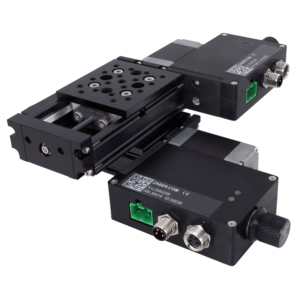
Actuation Type: Choose Linear Motors (LDM/LDQ) for frictionless, high-speed continuous scanning. Opt for Screw Drives (LSM/LRQ) when mechanical stiffness, high thrust, and power-off stability are required.
Guide Bearings: Crossed-roller bearings provide the highest stiffness and straightness for short-travel micro-positioning. Recirculating ball bearings are best suited for long-travel, high-load industrial applications.
Form Factor: If Abbe angular errors must be minimized, keep the payload as close to the bearings as possible by selecting low-profile stacked stages or integrating directly with our flat monolithic adapter plates.
Frequently Asked Questions (XY Stages)
How do you ensure orthogonality in an XY stage?
Orthogonality—the exact 90-degree squareness between the X and Y axes—is critical for planar accuracy. We ensure this through precision-machined mounting surfaces and factory-calibrated assembly, minimizing yaw and cross-axis runout so your payload moves exactly where commanded.
Can I add a vertical Z-axis to these XY tables?
Yes. Any of our XY configurations can be paired with our vertical lift stages using standard angle brackets. Because our systems share a unified communication protocol, adding a Z-axis is as simple as bolting it on and daisy-chaining the data cable.
What is the advantage of a built-in controller for XY positioning?
A built-in controller eliminates the need for separate rack-mounted electronics. It reduces the total cost of the system, eliminates signal noise associated with long encoder cables, and makes multi-axis synchronization significantly easier to program.