


































Class 1 Laser Safety: Everything You Need to Know
Most of us interact with Class 1 lasers every single day without giving it a second thought. The laser printer humming away in your office, the DVD player on your shelf, and the self-checkout scanner at the supermarket all rely on laser technology operating within tightly defined safety boundaries. Yet despite how commonplace they are, there is often a surprising amount of confusion about what Class 1 actually means, what the rules are, and what responsibilities fall on manufacturers, employers, and consumers alike.
In this comprehensive guide, we will walk you through everything you need to know about class 1 laser safety, from the underlying science of emission limits to labeling obligations, workplace regulations, and best practices for maintaining compliance throughout a product’s lifecycle. Whether you are a health and safety professional, a facilities manager, a manufacturer, or simply someone who wants to understand the technology sitting inside their office equipment, this resource is designed for you. Understanding proper laser product classification is the first step.
Understanding Class 1 Laser Classification
Definition and Fundamental Characteristics Under the international standard IEC 60825-1 (and the UK’s adopted standard BS EN 60825-1:2014), a Class 1 laser product is defined as one that is incapable of producing damaging radiation levels during all reasonably foreseeable conditions of operation. In plain terms: a correctly designed and intact Class 1 device cannot hurt you under normal use, including long-term direct viewing without any optical aids.
It is important to understand that Class 1 covers two distinct types of products:
- Intrinsically low-power devices: Lasers that are Class 1 by their very nature because the output power is so low it simply cannot cause biological harm.
- Enclosed higher-class devices: Products that contain a much more powerful internal laser (sometimes Class 3B or Class 4), but which are fully enclosed in a protective housing so that no hazardous laser radiation is accessible during normal use. A laser printer is a classic example of this type.
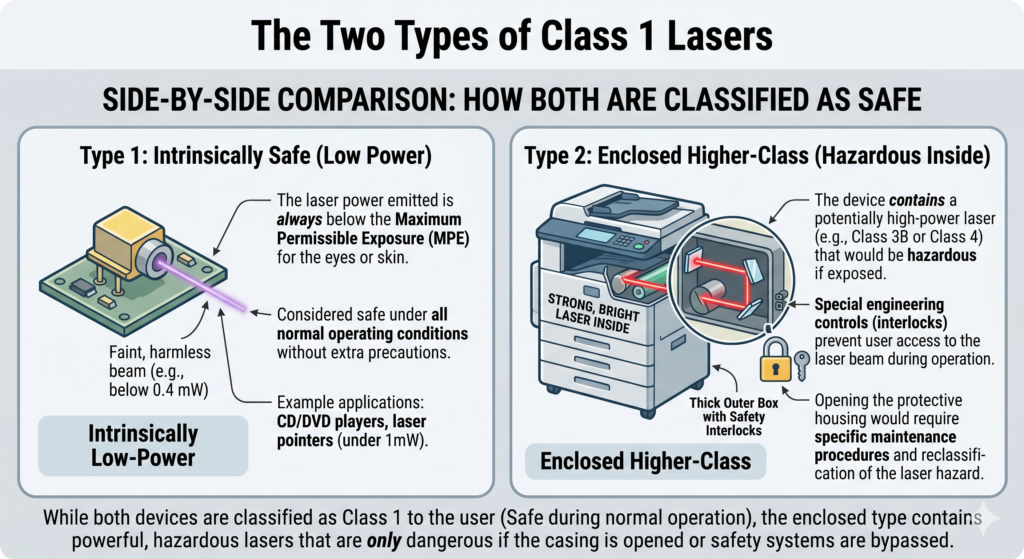
This distinction matters enormously in practice, particularly concerning servicing, maintenance, and what happens when an enclosure is opened.
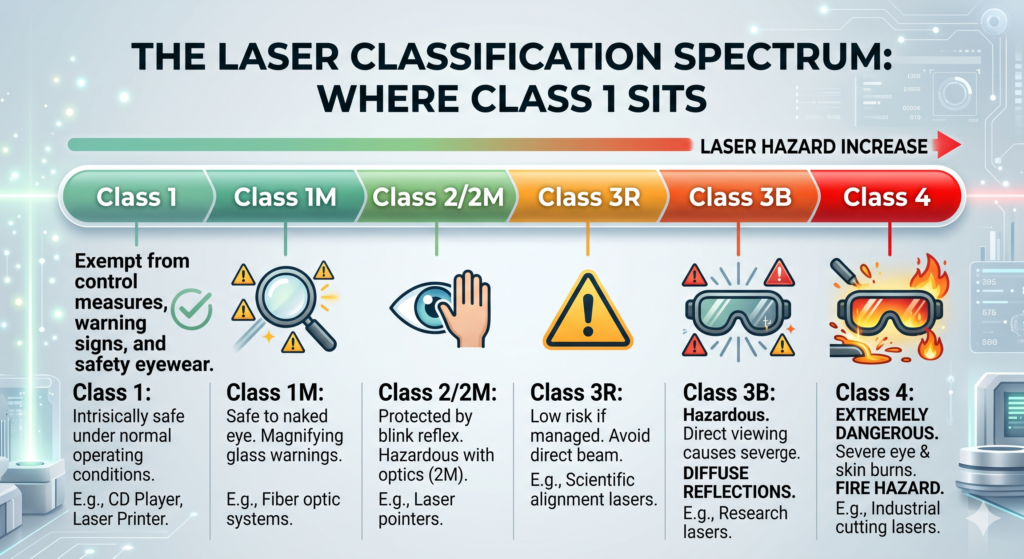
Class 1 Within the Broader Laser System To appreciate what Class 1 means, it helps to view the broader framework of laser product classification. The laser classification system runs from Class 1 (the safest) to Class 4 (the most hazardous). Class 1 sits firmly at the lowest hazard level, meaning these laser products are largely exempt from the control measures required for higher classes, such as controlled areas, warning signs, and mandatory safety eyewear.
It is distinct from Class 1C (designed for contact applications to skin) and Class 1M (safe for the naked eye but hazardous when viewed through magnifying optics). Because the obligations for laser class 1 are so minimal, it is the standard classification for most consumer and commercial electronics.
Emission Limits and MPE Levels
Behind every classification is a set of carefully calculated numbers. The core concept is the Maximum Permissible Exposure (MPE)—the maximum level of laser radiation an unprotected person can be exposed to without adverse biological changes to the eye or skin. The MPE varies depending on wavelength, exposure duration, pulse mode, and spot size.
Alongside the MPE is the Accessible Emission Limit (AEL). For a product to be classified as Class 1, its AEL must remain below the MPE under all normal operating conditions. These exposure limits are grounded in rigorous scientific data on dose-response relationships, creating a biologically robust framework that guarantees Class 1 devices genuinely cannot cause damage under normal circumstances.
Governing Standards and Regulatory Framework
The cornerstone of laser safety regulation worldwide is IEC 60825-1, one of the most critical standards in the industry. In the UK, this is adopted as BS EN 60825-1:2014, with a significant amendment (A11:2021) that introduced specific requirements for consumer goods. For US markets, ANSI Z136.1 is the equivalent standard, though manufacturers must navigate slight differences between these international standards. For a deeper dive into how equipment standards map to protective gear, see our Laser Safety Standards Guide: Decoding EN 207 & EN 208.
To bring a product to market, manufacturers must meet stringent class 1 laser safety requirements and rigorous testing standards. This involves demonstrating through accredited laboratory testing that accessible emissions remain within the AEL. It also demands strict compliance with local and international laser safety regulations, particularly those introduced specifically for consumer laser products.
While Class 1 lasers are inherently safe, structured risk assessments remain necessary in specific contexts, such as under the UK’s Control of Artificial Optical Radiation at Work Regulations 2010 (AOR 2010). Workplace assessments should verify accessible emissions, check overall enclosure integrity, and identify any non-optical hazards associated with the machinery, such as electrical or chemical risks.
Hazards, Exposure, and Eye Safety
Class 1 lasers are perfectly safe under normal operating conditions. A frequent question regarding class 1 laser eye safety is whether protective eyewear is required. The definitive answer is no. Emission levels permitted under Class 1 are set well below the biological thresholds capable of causing retinal, corneal, or lens damage, effectively eliminating the risk of eye damage and ensuring total class 1 laser product eye safety.
While temporary dazzling might occur in low-light environments, this is merely a temporary visual effect and does not constitute clinical harm. Because laser beam hazards are safely contained by design, users do not need mandatory eye protection for general operation.
However, the safety assumptions underpinning Class 1 status can be challenged if an enclosure is bypassed or damaged. When a protective housing containing a higher-class laser is compromised or opened for maintenance, the effective hazard level increases drastically. At that point, the safety controls appropriate to the internal laser class must be immediately applied. If you are tasked with servicing these internal components, it is critical to equip yourself properly. We highly recommend reading
Safety Features and Engineering Controls
The safety of enclosed Class 1 laser products relies on meticulous engineering rather than chance. The primary control is the protective housing, typically built from rugged materials capable of blocking direct, scattered, and reflected radiation.
Beyond the physical enclosure, key built-in safety features and protection measures include:
- Interlocks: Safety switches that instantly disable the internal laser if doors, panels, or removable housings are opened. Dual interlocks are often used to require two independent failures before radiation becomes accessible.
- Beam stops and attenuators: Physical barriers that block or reduce beam power to safe levels during specific operational phases.
- Optical viewing windows: Laser-safety glass that attenuates radiation to permit the safe observation of internal processes.
Laser printers, CD/DVD drives, and enclosed retail barcode scanners all utilize these design principles to ensure that no hazardous radiation escapes during daily use. To maintain this classification throughout a product’s lifecycle, any servicing must follow documented procedures, use approved replacement parts, and be conducted solely by authorized personnel.
Labelling and Product Information Requirements
Proper labelling is a highly visible component of compliance. Under IEC 60825-1, all laser devices must carry a visible classification label. The class 1 laser safety label is deliberately straightforward, usually stating “Class 1 Laser Product” without the severe hazard symbols, aperture labels, or warning text required for higher classes.
However, a crucial distinction exists for embedded Class 1 products. If the device achieves Class 1 status via an enclosure around a higher-class laser, it must feature internal warning labels. When a service technician opens the casing, these internal labels clearly communicate the true classification of the enclosed laser and the necessary safety precautions required to work on it.
Furthermore, manufacturers must supply product information labels featuring traceability details (like serial numbers and date codes) alongside comprehensive user manuals. Reading these product information labels is essential for safe operation and lifecycle tracking. These product information labels must explicitly outline safe operating conditions and strongly warn users against defeating interlocks or tampering with the external enclosure.
Class 1 Laser Safety in Workplace and Consumer Environments
In the workplace, the primary obligation for employers using laser equipment is simple: ensure standard equipment maintenance and safe usage. Because Class 1 devices pose no foreseeable risk under normal conditions, employers do not need to appoint a dedicated Laser Safety Officer (LSO) or establish controlled areas for general staff.
However, providing basic safety training for maintenance staff handling enclosed higher-class lasers is highly recommended. Regular safety training ensures that employees know to report equipment damage immediately and never attempt to bypass integrated safety features. If an enclosure breach is discovered, the device should be immediately taken out of service until it is professionally evaluated and repaired.During this repair phase, temporary controlled areas must be established to protect bystanders; this can be achieved using permanent installations like Laser Safety Blinds: The Complete Guide for UK Facilities or portable solutions like a Laser Safety Barriers – Roll-up barrier setup [VIDEO].
For consumers using standard devices like printers, optical drives, or fiber-optic networking equipment meant for home use, responsibilities are equally light. As long as the product is used exactly as intended and the outer casing remains intact, Class 1 laser technology delivers reliable performance with guaranteed safety1