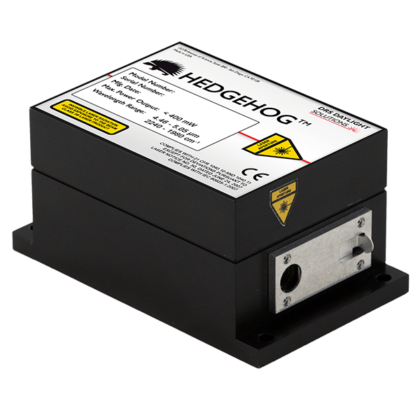
Programmable Pulsed Laser
- Programmable nanosecond pulse shapes
- 0.1 ns to CW
- Average power up to 20 mW
- Extinction ratio up to 70 dB
- FC/APC output, polarisation maintaining
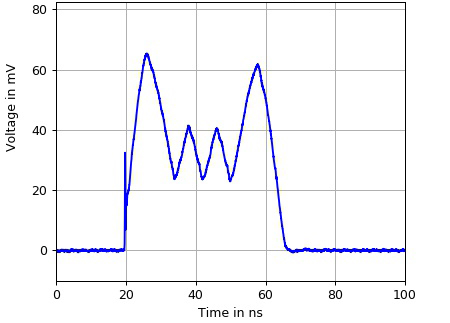
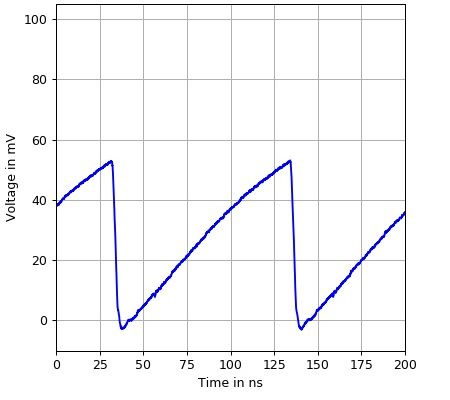
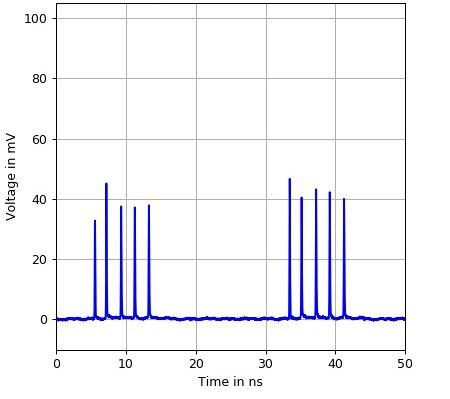
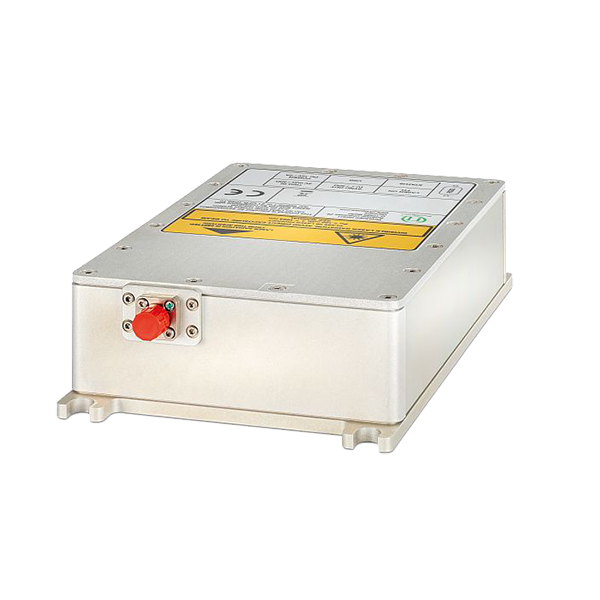
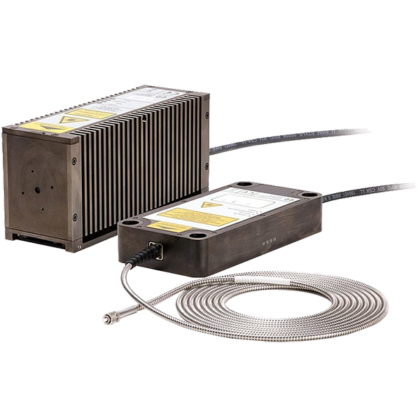
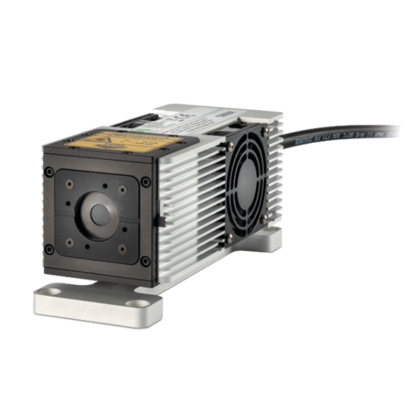
The PPL 512 / PPA 512 is a stand-alone, computer controlled laser platform for the generation of nanosecond pulses with programmable pulse shapes. The resulting laser signal, featuring the defined pulse shape, is then output to a single mode fibre. In order to program the pulse shape, the PPL 512 / PPA 512 is connected to a host computer via a standard USB interface. The very compact form factor makes it ideal for integration into larger amplified laser chains. By programming fast current slopes, not only nanosecond pulses can be generated but also gain switched operation becomes possible, which results in picosecond optical output pulses. Also, undesired ringing effects at fast switch-on transients can be reduced by defining specific current ramps. Moreover, saturation effects of optical amplifiers can be pre-compensated, which makes the device an ideal seeding source for fibre or solid-state amplifiers.
Programming arbitrary pulses profiles – byte by byte
The PPL 512 / PPA 512 is based on a programmable waveform platform capable of generating pulse patterns in a cyclic sequence of 512 bytes. The 512 bytes are stored in a special high-speed memory that can be read out at the full speed of 5 GS/s. This results in a timing resolution of 200 ps per byte (other values may be made available on request). With such a 512 byte data set, arbitrary pulse shapes can be defined with an amplitude resolution of 8 bits (0 to 255). This pre-defined sequence can then be run as a gapless loop at the full speed of 5 GS/s or started and stopped by an external control signal.
One laser platform, multiple variations
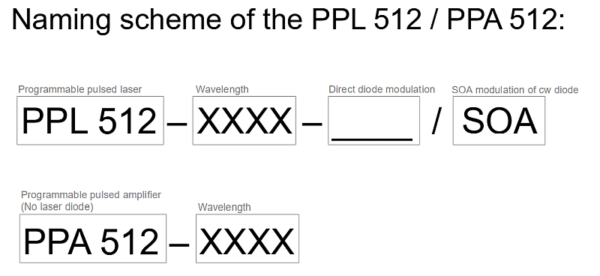
Multiple model versions can be derived from the main PPL 512 / PPA 512 laser platform, depending on the internal architecture and mode of modulation. The available palette encompasses:
- The direct modulation of the laser diode (PPL 512 – xxxx [1] )
- The modulation of the CW driven laser diode via a semiconductor optical amplifier (PPL 512 – xxxx SOA [1] )
- The modulation via a semiconductor optical amplifier NOT including the CW diode (PPA 512 – xxxx [1] )
The PPL 512 / PPA 512 can be configured to provide programmable pulses at wavelengths such as 1030 or 1064 nm, 1.5 or 2 µm, as well as many wavelengths in the visible range.
[1] The “xxxx” label indicates the laser’s emission wavelength
| Mainframe |
|---|
| Power input voltage | 12 V (max. 18 V) |
| Current | max. 1.7 A |
| Amplitude | 50 mVrms typ., 2 Vrms max. |
| External power supply | 100 to 240 VAC, 50/60 Hz, max 100 Watt |
| Connector type | LEMO EXG0B302HLN-A |
| Dimensions | 210 × 118 × 47.4 mm (W × D × H) |
| Net weight (laser head) | 0.8 kg |
| Total weight (incl. power supply, etc) | 1.6 kg |
| Power dissipation | max. 20 W |
| Operating Temperature | 15 to 35 °C |
| Pulse Pattern |
|---|
| Length | 512 bytes |
| Readout speed | 5 GS / s; 200 ps time bins; other sampling rates < 5 GS / s on request |
| OP Mode Input |
|---|
| Amplitude | > 0.75 and < 1.1 V continues pattern generation with byte 0 after reading all 511 bytes
< 0.2 V: pattern generation stops after reading 508 bytes unconnected: free-running mode |
| Impedance | 500 Ohms |
| Connector | SMA (female) |
| Synchronisation Output |
|---|
| Amplitude | +500 mV into 50 Ohm; falling edge at byte 253; rising edge at byte 508 |
| Impedance | 50 Ohm |
| Connector | SMA (female) |
| Status Output |
|---|
| Amplitude | 5 V for Laser ON; 0 V OFF |
| Impedance | min. 10 kOhm |
| Connector | SMA (female) |
| USB 2.0 UART (Virtual COM Port) |
|---|
| Connector type | Mini-USB 2, type B |
| Baud rate | 115200 |
| Data | 8 bit |
| Parity | none |
| Stop | 1 bit |
| Optical Output |
|---|
| Fibre receptacle | FC/APC, narrow key, PM single mode optical fibre built in optical isolator |
| Max. reverse launched power | < 50 mW |
Wavelengths
The table below is a non-exhaustive list of possible variants. Please contact PicoQuant, other wavelengths are available on request, high power fibre preamplified version available on request.
PPL 512 models
Type
PPL 512 – | Wavelength
[nm] | Min. Pulse Duration
[ns] | Rise / Fall Time
[ps] | Max. Avg. Power
[mW] | Extinction Ratio | Linewidth (FWHM)
[nm] | Optical Input |
|---|
| – 1030 | 1030 ± 2 nm | 0.1 | typ. 50 | 20 | > 20 dB | typ. < 0.1 | none |
| – 1030; – SOA | 1030 ± 2 nm [1] | 0.5 | typ. 250 | 20 | > 50 dB | typ. < 0.05, near transform limited | none |
| – 1050 | 1053 ± 1 nm | 0.1 | typ. 50 | 20 | > 70 dB | typ. < 0.1 | none |
| – 1050 – SOA | 1053 ± 1 nm [1] | 0.5 | typ. 250 | 20 | > 50 dB | typ. < 0.05, near transform limited | none |
| – 1060 | 1064 ± 1 nm | 0.1 | typ. 50 | 20 | > 70 dB | typ. < 0.1 | none |
| – 1060 – SOA | 1064 ± 1 nm [1] | 0.5 | typ. 250 | 20 | > 50 dB | typ. < 0.05, near transform limited | none |
| – 1550 | 1550 ± 20 nm [2] | 0.1 | typ. 50 | 20 | > 70 dB | typ. < 0.1 | none |
| – 1550 – SOA | 1550 ± 20 nm [1,2] | 0.5 | typ. 250 | 20 | > 50 dB | typ. < 0.05, near transform limited | none |
[1] Enhanced central wavelength stability
[2] Exact wavelength on request, any between 1530 and 1570 nm
PPA 512 models
Type
PPA 512 – | Wavelength
[nm] | Min. Pulse Duration
[ns] | Rise / Fall Time
[ps] | Max. Avg. Power
[mW] | Extinction Ratio | Linewidth (FWHM)
[nm] | Optical Input |
|---|
| – 1030 | 1030 ± 5 nm [1] | 0.5 | typ. 250 | 20 | > 50 dB3 | N.A. [2] | FC/APC fibre receptacle, polarisation maintaining.
Max CW input power: 20 mW [3] |
| – 1060 | 1060 ± 10 nm [1] | 0.5 | typ. 250 | 20 | > 50 dB3 | N.A. [2] | FC/APC fibre receptacle, polarisation maintaining.
Max CW input power: 20 mW [3] |
| – 1550 | 1550 ± 20 nm [1] | 0.5 | typ. 250 | 20 | > 50 dB3 | N.A. [2] | FC/APC fibre receptacle, polarisation maintaining.
Max CW input power: 20 mW [3] |
[1] PPA does NOT include the laser diode, the range of wavelengths shown corresponds to the acceptable wavelengths for the laser diode to be coupled externally
[2] Depends on the CW laser input
[3] The best performances in terms of extinction ratio are achieved for a CW input level of 5-8 mW, higher input power leads to more output power but a slightly decreased extinction ratio.